 Registration Guide Register for HPC Access to HPCNew User Guide How to Run Batch Jobs Portal User Guide About the Service Subscribe to Pay-Per-Use Service Subscribe to Condominium Service Terms and ConditionsUser GuideHigh Performance Workspace Service Utility Storage ServiceResearch Data Management Service
Centre for Computational Science & Engineering
 |
||
| Need help? | ||
|
||
 |
||
Introduction
In a research environment, High Performance Computing (HPC) is the use of hardware, software, tools and programming techniques to accelerate research computation, which in turn will enable the execution of large cutting-edge research simulation that accelerates new discoveries. At the National University of Singapore, a combination of centralized and distributed approaches has been adopted in the provisioning and support of High Performance Computing (HPC) for research computation. In this hybrid environment, some departments and research groups are providing local resources to support their users, whereas the HPC team at the NUS Computer Centre is focusing on providing central HPC resources and services to support all staff and student researchers across campus.
Central HPC support at NUS Computer Centre began in 1989 when a shared vector supercomputer was made available to the NUS research community. Since then, a variety of HPC systems and technologies had been introduced to meet wide range of research computing requirements, which include cc-NUMA multi-processor system, Linux and Windows based cluster parallel computing system, remote visualization system, parallel file system, Grid computing resources, and more recently the multi-core parallel computing system.
In a continuing effort to improve ease of use and to enable anytime anywhere access to HPC resources, a number of operational initiatives had been carried out in the past few years. For example, a HPC Portal had been developed to enable browser based access to the compute and visualization resources and services. The Unix and Linux authentication and access control had been integrated with the central Active Directory to enable single account and password to access both research and non-research services and resources. Integration of user accounts with central Active Directory greatly reduced the efforts to manage local accounts on the large number of compute nodes in the clusters. In addition, user home directory had been integrated with the central file system to allow seamless access of file and data across laptop, desktop and server, enhancing the ease of use of HPC resources further.
To access the central HPC resources and services, NUS staff and student can register online through the HPC Portal. The following figures provide an overall view of the central resources and services provided by NUS Computer Centre today:
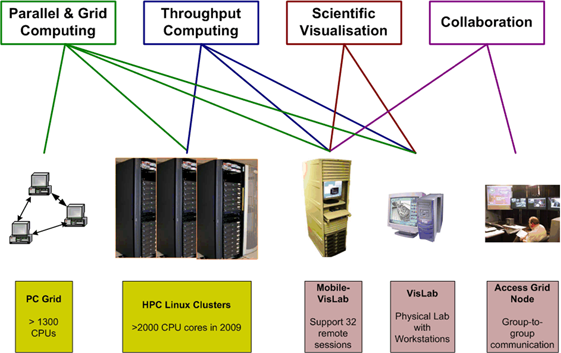
Figure 1: HPC Hardware and Services
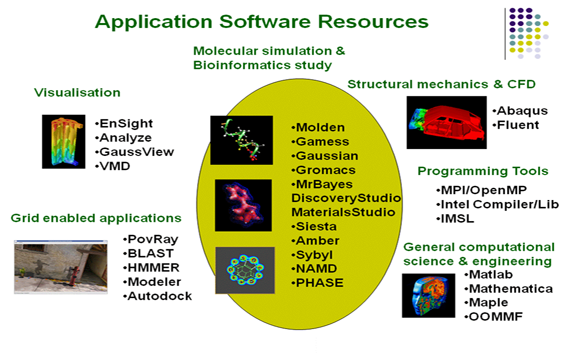
Figure 2: Commercial and Open Source Software Supported
HPC Development Milestones at NUS Computer Centre
2008- User authentication and access control was integrated with the central Active Directory to enable single account and password access to both HPC and non-HPC resources and services.
- User home directory was expanded and integrated with the central storage and file system to enable seamless access of files and data across laptop, desktop and HPC systems.
- HPC Portal was upgraded to enable online account registration, cutting the account application time from days to around one hour.
- The second multi-core HPC cluster was introduced with a total of 768 cores, expanding the overall cluster computing pool to more than 1200 CPU cores.
2007
- The University introduced the first multi-core server cluster with a total of 336 processor cores, doubling its HPC capability to an aggregated computing power of 1.99 Teraflops for researchers.
- The first Windows-based HPC cluster was introduced to provide staff with relentless parallel computing resources right from their desktop PC.
2006
- TCG@NUS (Tera-scale Campus Grid at NUS) clinched the winning CIO Award 2006, beating more than 100 nominations from the public and private sectors in the region. The award further recognizes the cross-faculty efforts in harnessing idle computing cycles from existing desktop PCs on campus.
2005
- Planned PC Grid expansion to include up to 1000 PCs. Data Grid to support BioInformatics applications.
2004
- The Grid Innovation Zone was established with IBM and Intel to promote Grid computing technology.
- The following were developed as part of the NUS Campus Grid project:
- Grid Portal
- First Access Grid node on campus. Adoption of IA64 technology and further expansion of cluster system had raised the capacity further to 844.84Gflops.
2003
- The first Grid computing system (PC Grid with 120 PCs) was developed. The combination of Grid and cluster implementation had further boosted the computing capacity by another 3 folds (593.80Gflops).
2002
- Adoption of open source based cluster technology had boosted the HPC capacity by more than 3 folds (193.16Gflops).
- Implementation of the high-performance remote visualisation system.
2001
- The HPC portal was launched to provide anytime anywhere web based access to HPC resources.
2000
- The installation of the Compaq Alpha HPC systems had boosted the HPC capacity further by more the 4 folds (52.36Gflops).
- The SAN storage was introduced to enhance the storage capacity for HPC.
1998
- The installation of the SGI Origin2000 HPC system and the adoption of the cc-NUMA architecture had boosted the HPC capacity by about 4 folds (9.52Gflops).
1996
- The number of research projects supported exceeded 100 for the first time.
1995
- The Supercomputing & Visualisation Unit was set up at Computer Centre to support and promote High Performance Computing on campus.
- NUS installed the first Cray Vector Supercomputer (Cray J90) in the region on campus (2.4Gflops). (Gflops - Billions of floating-points operation per second).
- NUS set up the Visualisation Laboratory at the Computer Centre to provide high-end scientific visualisation resources to support research activities on campus. The Laboratory was equipped with the state-of-the-art SGI Onyx visualisation system. An MOU was signed by NUS and SGI to promote high-end visualisation technology on campus.
