Office of Risk Management
and Compliance

Safety · health · wellbeing

Total Workplace Safety and Health

Total WSH @ NUS brings workplace safety and health promotion together to support a safe and healthy working environment for staff and students.

“Under Total WSH, we will achieve better integration of safety, health and well-being in the workplace.”

Professor Tan Eng Chye, NUS President
↗Understand the approachSee how Total WSH brings the elements together▤Explore resourcesFind NUS and national guidance?Ask about Total WSHContact the programme team

A joined-up view of work

Safety, health and wellbeing are connected

Total WSH is a holistic, integrated and proactive approach to managing work, safety and health together. It considers the work environment and processes, how work is organised, and individual health factors.

Why Total WSH @ NUS?

NUS is committed to providing a safe and healthy working environment for all staff and students. The University is progressively implementing Total WSH across departments, with the support of senior management.

Integrated assessment helps identify workplace risks and health needs together. Departments can then consider suitable health promotion and intervention programmes alongside improvements to work and working conditions.
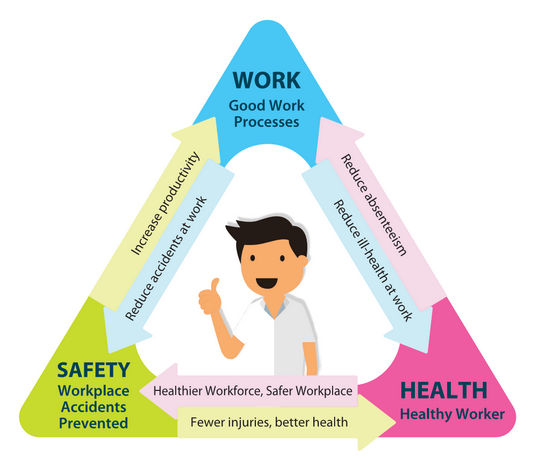
Total WSH triangle showing the connected components of workplace safety, occupational health and health promotion
Figure 1. Components of Total Workplace Safety and Health. Source: Saw Swee Hock School of Public Health, NUS.

NUS President’s address on Total WSH

If the video does not load, watch the NUS President’s address on YouTube.

The Total WSH model

Three connected pillars

Look at the whole work system: the environment and tasks, the way work is arranged, and the health factors that can affect people at work.

Pillar 01

Workplace safety

Consider the physical work environment and work processes, including exposure to hazardous materials and manual handling.

Pillar 02

Occupational health

Consider how work and workplace conditions may affect health, and identify appropriate measures to prevent or manage work-related health risks.

Pillar 03

Health promotion and wellbeing

Consider work organisation and individual health factors, and support suitable health promotion and intervention programmes.

Assessment may consider: the physical work environment and processes; work organisation such as prolonged working hours or shift work; and individual health factors such as pre-existing health conditions and age.

Putting integration into practice

A proactive, integrated cycle

Total WSH uses broad assessments to understand risks and needs, then supports departments in selecting and reviewing suitable actions.

1

Understand the work

Review work activities, processes, workplace conditions and how work is organised.

2

Assess risks and needs

Consider safety, occupational health and wellbeing together, including relevant individual health factors.

3

Plan suitable action

Identify improvements and health promotion or intervention programmes suited to the department.

4

Review and improve

Use the findings to guide ongoing improvements to safety, health and wellbeing at work.

Common questions

Total WSH FAQs

Choose a question to read its answer. Topics include the health assessment, confidentiality and available programmes.

Are individual survey responses anonymous?

Yes. Individual respondents cannot be identified from their survey responses. Responses are treated as anonymous.

What are Basic Health Insight results used for?

Basic Health Insight (BHI) is a health needs assessment tool that captures baseline health information, including basic demographic information, height and weight, work ability, chronic disease status, previous basic health screening, stress level, lifestyle practices, perceived work environment and musculoskeletal symptoms. Collated results are used in aggregate to understand a department’s health needs and identify suitable health promotion or intervention programmes.

What intervention programmes are available?

NUS offers programmes that promote health and healthy living for staff and students, including mental wellness programmes and counselling. Refer to the University Health Centre, Office of Human Resources, and NUS Health & Wellbeing for current information.

Can a department engage an external service provider?

Yes. A department may engage its own service providers for intervention programmes, in addition to enterprise-level programmes offered by the University.

Do individuals need to disclose personal health factors to their PI or supervisor?

No. Individuals do not need to disclose their personal health information to their PI or supervisor for the risk assessment. The assessment is generic and incorporates health risk factors relevant to work activities, such as musculoskeletal conditions in manual lifting.

What is the NUS Staff Health Survey?

The NUS Staff Health Survey is part of the Total WSH programme and supports NUS’s aim to integrate safety, health and wellbeing into work practices and conditions. Launched in 2023, it is a collaboration between the Safety and Health Unit in ORMC, University Health Centre, Health & Wellbeing at the Office of the President, and Office of Human Resources. Staff are randomly selected to participate. Responses are anonymous and confidential; the survey helps NUS understand staff physical health and mental wellbeing needs.

Programme enquiries

Contact Total WSH @ NUS

For enquiries about Total WSH @ NUS, contact the Office of Risk Management and Compliance.

Back to top